
Narcissism and the Geftakys Assembly
This discussion of narcissism is based on the Fourth Edition of the Diagnostic and Statistical Manual of the American Psychiatric Association. Further information on NPD can be found at Ptypes Personality Types.
 Jon Krakauer in his book Under the Banner of Heaven makes
the following comments about NPD:
Jon Krakauer in his book Under the Banner of Heaven makes
the following comments about NPD:
Although an exaggerated desire to mete out justice is not listed among the defining characteristics of narcissistic personality disorder in DSM-IV, it probably should be. Narcissists erupt with self-righteous indignation whenever they believe others are breaking rules, acting unfairly, or getting more than their fair share of the pie. They have no compunction about breaking the rules themselves, however, because they know they're special and the rules don't apply to them....When narcissists are confronted by people who disparage the legitimacy of their extravagant claims, they tend to react badly. They may plunge into depression -- or become infuriated...Their reaction to criticism is intense.
Krakauer quotes Anthony Storr from Feet of Clay:
Gurus are isolated people, dependent upon their disciples, with no possibility of being disciplined by a Church or criticized by contemporaries. They are above the law. The guru usurps the place of God. Whether gurus have suffered from manic-depressive illness, schizophrenia, or any other form of recognized, diagnosable mental illness is interesting but ultimately unimportant. What distinguishes gurus from more orthodox teachers is not their manic-depressive mood swings, not their thought disorders, not their delusional beliefs, not their hallucinatory visions, not their mystical states of ecstasy: it is their narcissism.
Lack of empathy is characteristic of "NPD". Hmmm. It is intriguing to consider that perhaps the chief Assembly doctrine of death to self was implemented because of George Geftakys' narcissism. George felt and Betty knew that it was necessary for members to feel guilt and shame about their true selves and to work assiduously to deny themselves because that is what was required to live in the orbit of a narcissistic personality who did not leave room for the unique personalities, needs, interests or talents of others, unless they were useful to his self-aggrandizement.
Grandiosity is a hallmark of "NPD". Perhaps doctrine was skewed in the Assembly to denigrate initial salvation and forgiveness of sins and emphasize instead the deeds of royal overcomers, because these enhanced self-importance. It was very important to George that his own "passport" had been granted, assuring him that he had attained overcomer status. By conforming to high performance standards, we as a group became one of George's superior achievements.
It is a sobering thought that many people were also deliberately trained and discipled to model themselves after Assembly leaders who lorded it over others. Residual traces of narcissism can be seen in some of us at times -- intense reaction to criticism, need to be important, exploitation of other people, lack of empathy, even arrogance.
The most tragic implication, however, is that because a spiritual leader communicates to the people who God is and what He is like, subconsciously God may feel demanding and exploitative, lacking in empathy, and willing to associate only with certain special high-status individuals. If the leader has no time or interest in just spending time with us, enjoying us as people, listening, loving, rejoicing with our joys and weeping with our sorrows, it may feel that God doesn't either.
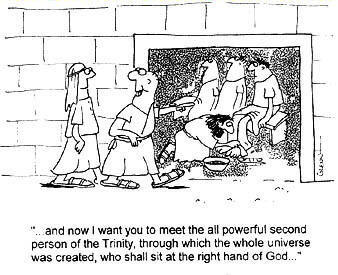
God is not a narcissist. The Bible is clear that even though God is high and holy, yet He does continually take thought for the lowly. Even though He deserves all admiration, yet He humbled Himself to become one of us, and promises to never leave us nor forsake us. He wants us to pour out our hearts before Him, because He wants communion with us. He delights in our unique individuality, because He created our inmost being. We are each so valuable to Him that even the very hairs of our head are numbered!
This cartoon sums up the contrast.
Next: Malignant Narcissism - The Drama
Previous: Malignant Narcissism:
Excerpts from
People of the Lie
Further reading related to narcissism:
Could There
Have Been a Few Sociopaths among Us?
Cult of
the Narcissist
Emotional Abuse, Verbal Abuse - the Very Early Warning Signs
The Abuser's Body Language
Liars' Brains Are Wired Differently
Evil: Self-Examination
