
Cult Dynamics of the Assembly
• Unaccountable Authoritarian Leadership
• Narcissism
• Invasive Control
• Mind-Numbing Indoctrination
• A Foundation of Twisted Doctrine
• Cult Dynamics in People's Lives
• Assembly Documents
Prospective recruits were initially attracted to the Assembly because it was serious about God, and there was a lot of fellowship. The cult dynamics were hidden under the constant barrage of Bible teaching and spiritual-sounding language. Dr. Janja Lalich defines four major characteristics of a cult: an authoritarian leader, a transcendant belief system, systems of control, and systems of influence. She describes the functioning of an abusive group in this way:
I define an abusive group as a particular kind of relationship; it can be a group situation or between two people. Within that relationship there is an enormous power imbalance, but more than that, there is a hidden agenda. There is deception, manipulation, exploitation, and almost certainly abuse, carried out and/or reinforced by the use of social and psychological influence techniques meant to control behavior and shape attitudes and thinking patterns.
Such a group is led by a person (or sometimes two or three) who demands all veneration, who makes all decisions, and who ultimately controls most aspects of the personal lives of those who are cleverly persuaded that they must follow, obey, and stay in the good graces (i.e., in the grip) of the leader.
Dr. Lalich's podcast interview on 'What is a cult?' expands on this description. She gives one of the best detailed explanations out there on how to identify the harmful cultic aspects of a group.
Unaccountable Authoritarian Leadership
• Tom Maddux analyzed Assembly leadership in terms of Dr. Philip Zimbardo's infamous Stanford "prison experiment. "Are Christians Susceptible to Psychological Manipulation?" is the question that was raised on the Assemblyboard.
• Through the Workers meetings George directly excercised his control. Detailed notes and audio captured in action. These quotes show the mind control at work. The Workers were being coerced to change their way of thinking from how people normally look at things to a distinctly cultic perspective.
• Where did the money go? George tolerated no accountability for the cash donations he received as personal gifts and did not report to the IRS.
• The role of the Leading Brothers was crucial.
• In Who's Your Daddy? Dave Sable explores a plausible explanation why Brother George became to people the father they longed for.
• "An Open Letter to Assembly Folks" was from a second-generation adult who was also a Worker.
Narcissism
To say that there was malignant narcissism in the Assembly may seem shocking and extreme, but we should at least seriously consider the possibility. Certainly there were devastating effects on many lives. Dr. Lalich in the podcast referenced above says that most cult leaders are narcissists.
Scott Peck, in his book People of the Lie, proposes malignant narcissism as a category of psychopathology. Here are three brief perspectives on malignant narcissism:
• Narcissistic Personality Disorder (NPD)
• Characteristics of Malignant Narcissism
(quotations from People of the Lie)
• The Assembly enacted George's narcissistic fantasy that he was a
great man who had recovered the Lord's vision for His church.
Children in the cult of a narcissist are especially at risk.
Were There a Few Sociopaths among Us? asks the question about the Assembly using the criteria of the DSM-IV and excerpts from the book, High Risk: Children Without a Conscience.
The proper term for George's behavior with young women in the Assembly is clergy sexual abuse. In regard to Kristin's story, some may think it was not a case of "clergy sexual abuse"--after all, the Assembly didn't believe in "clergy". But the issue isn't the terminology. The issue is the power differential. Bear in mind that "Brother" George was not simply "George", and not even "brother George, a brother amongst brethren", but "Brother" capital "B", at his insistence. Sexual contact between a pastor and a church member is often dismissed as an "affair" between "consenting adults". It is not.
We received an email from a Watchman Nee researcher who found this website. After reading about G. Geftakys, he wrote to us, "Watchman Nee did the same thing." The Brethren principle of lack of accountability to any governing body allows this to happen unchecked.
On this website, the term 'collusion' is used to describe the collaboration, conscious or unconscious, of two or more individuals to protect those engaged in unethical practices from exposure. Collusion allowed George's sexual abuse and David's domestic violence to go unchecked for 25 years. The following links show that collusion around the issues of clergy sexual abuse and clergy domestic violence happens in many churches.
• Basic Facts About Domestic Violence & Collusion
• Collusion Is Just a Symptom
• Parallels with Family Dynamics of Addicts
The Hope of Survivors website has a number of articles dealing with clergy sexual abuse. Here is a link to a brief synopsis of other misconceptions and misunderstandings about clergy sexual abuse.
Invasive Control
• Every hour of every day was scheduled so that behavior and thought could be controlled.
• Married couples and children were particularly targeted.
• Singles were not exempted. In fact, they bore a particularly heavy load.
• Did you know that the Assembly is categorized as a T.A.C.O. by a well-known cult expert?
• Wayne and Pat M. provide these anecdotes (puzzle pieces) that fit very nicely into the Assembly puzzle. Here are a few more insightful pieces to the Assembly puzzle.
• The Origin of White Glove Inspections - Betty viewed the training houses like her alma mater Bob Jones University viewed itself - as substitute parents.
• Of Gnats, Camels and Televisions shows the dynamics of Assembly control through legalism that majors on the minors.
• The characteristic cult emphasis on recruiting new members is shown in Chris and Mary's story. Tim Geftakys's "Four Anchors" was an ingenious tool used over a period of months.
• Errors found in the doctrine and practice of the Assemblies are exposed by a former member of the Spokane Assembly.
• In November, 2002, Brent T. wrote Fear, Pride and False Virtue: The Weapons That Protect the Assembly.
• Tom Maddux explores the inversion of the proper priorities of loyalty in the Assembly, and the results of this inversion.
• Interviews with former Assembly members are included in an article by Dr. Ronald Enroth. He sent us a heads-up.
• "The Selfer's Prayer" brought the control down to the granular level of thoughts and atttitudes. Readers had strong reactions about using this prayer.
• This program ensured that the Assembly would embody the doctrine of the "The Candlestick of Pure Gold."
Detailed control of personal relationships came into play especially in relationships..
• All the classic criteria for thought reform were incorporated in the Assembly. Brian Steele demonstated how this worked in a paper he wrote when he was at Wellspring. Gretchen W. also analysed her experience in the Omaha Assembly in terms of Lifton's criteria.This fictional Assembly dialogue captures it. "Anonymous" on the AssemblyBoard had this observation.
• Brent T. wrote about the unspoken code of silence in the Assembly.
• During the collapse of the Assemblies in early 2003, a former member of the Lombard Assembly wrote a brief piece on Assembly Friendships.
• Leaving the Assembly was written by Eric B., a former San Fernando Valley Assembly member, in 2002. He discusses excommunication, shunning, and other methods brought into play when people left the Assemblies.
• Assembly similarity to the 3HO cult turned the lights on for Rachel Geftakys in 2002. Aspects that rang an Assembly bell:
• 3HO Dysfunctional Family: Don't Talk, Roles, Sex
Roles
• Personality Roles: The Hero, The Scapegoat,
The Forgotten Child
• Keeping Safe
• Network of Lies
• Personality Types: Grief-on-top-of-Rage,
Co-dependents
• Pit of Rage, Keeping Up, Talking About Mom and Dad's
Problem
• Denial
• 3HO Forfeited
• Conclusion
• TH in SoC is a blog by a former Assembly member from Fullerton and later Placentia. Many of the posts are about the Assembly, bringing a unique perspective and many valuable insights.
Mind-Numbing Indoctrination
• Generally speaking, indoctrination in 'Overcomer' beliefs and behavior happened every day of the week in the many meetings, the communal living and the outreaches.
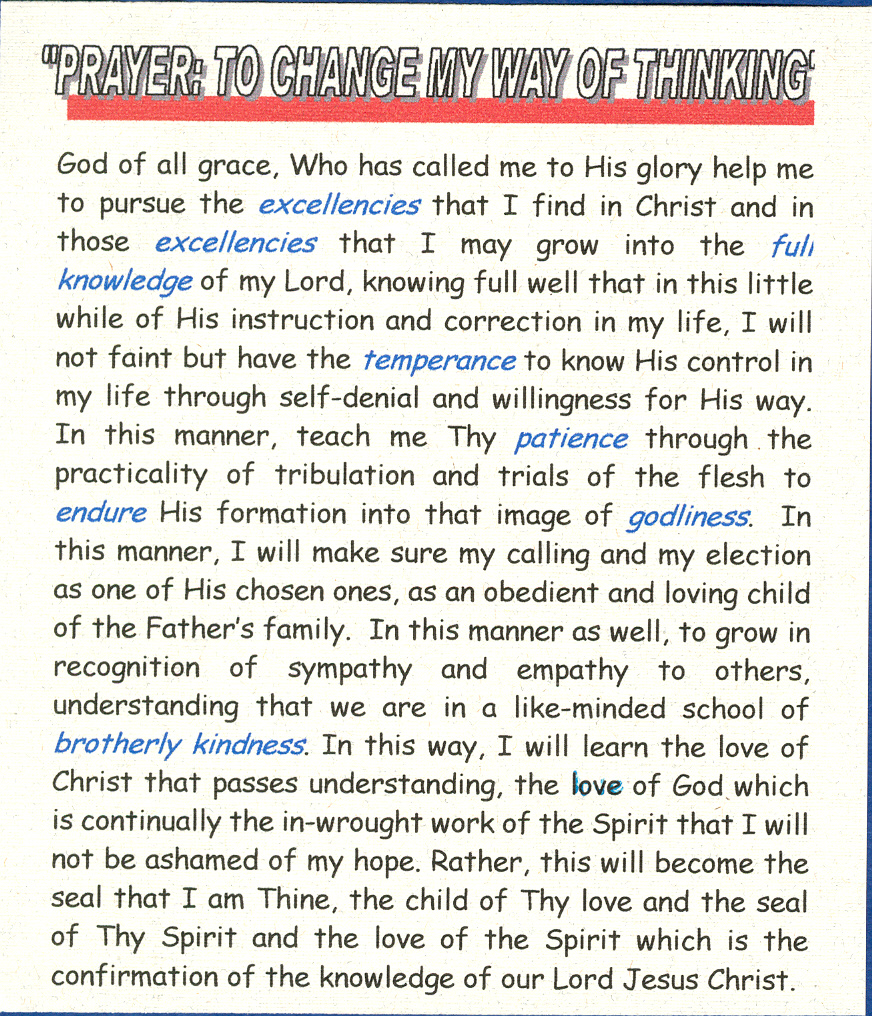
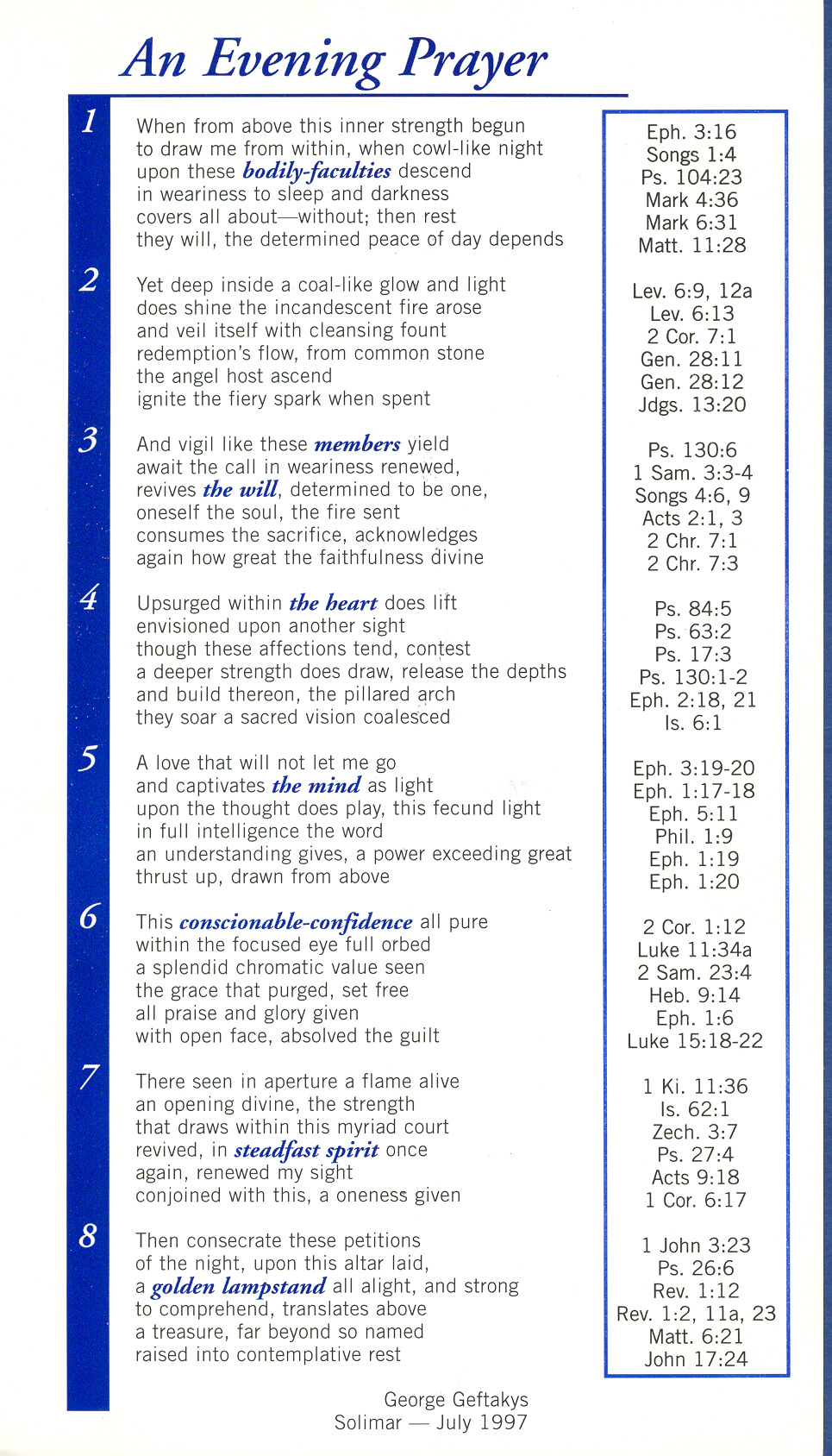
• More specifically, George and Betty introduced prayers that were to be constantly used by the saints. They were a potent means of indoctrination. The Selfer's prayer was one of the main tools of mind control. In Betty's hand it became a weapon of destruction.
Steve Irons analyzed 'The Heavenly Ladder', which morphed into 'The Cycle of Devotion' which was published as 'A Morning Prayer'.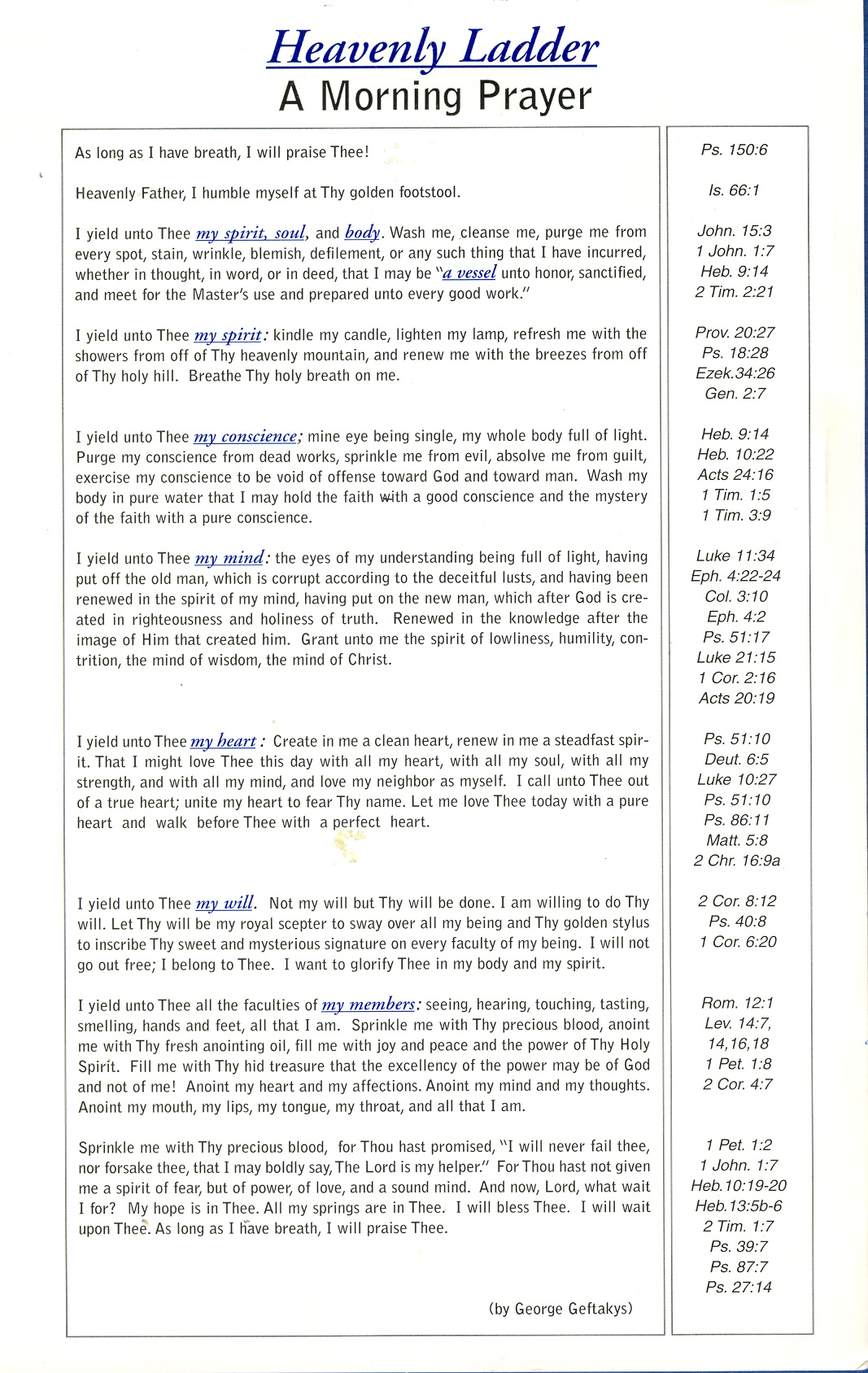
• Other prayers were 'Prayer to Change My Way of Thinking', and 'An Evening Prayer'. Betty handed out bookmarks, as well.
• Many other handouts and publications were developed to indoctrinate us.
• "A tool of bondage..." is how people described The Handbook to Happiness on the AssemblyBoard. It ensured subordination to the Assembly system.
• When George was accused of brainwashing young people, he replied, "Yes, I am. Who would you rather brainwash them, me, or the world?" A major difference between normal persuasion and unethical influence is deception. In ordinary social influence the goal is understood up front. With the Assembly, people were not fully informed about what meant to 'make a committment to fellowship'.
• Incredibly strong and enduring mental roadblocks were formed in our minds. It also wreaked spiritual devastation because it was done in God's name.
• The Assembly used the same six fundamental social and psychological principles that successful marketers use on us every day. It is manipulation, an unethical use of persuasion.
• An excellent explanation of mind control discards the image of "mindless robots" and incorporates instead the very helpful concept of "mental roadblocks"
• Tom recommends Biderman's Chart of Coercion. Here is a fuller explanation of the chart.
• Steve Hassan on his website, "Freedom of Mind", charts a continuum of influence, from positive to negative.
• A detailed chart (p.2) of the continuum of influence and persuasion ranges from legitimate education, to advertising, to propaganda, to legitimate indoctrination (such the military), to unethical thought reform.
Further Reading on Thought Control
Dangerous Persuaders, by Australian psychologist Louise Samways, is a brief, thorough and excellent explanation of how people are drawn into abusive organizations, how the coercive systems of influence work, and what it takes to get free. Highly recommended!
Dr. Kelton Rhoades, a professor at USC, addresses questions about cults on his website, Working Psychology. His site is dedicated to the scientific investigation of persuasion and influence. See An Introduction to Social Influence and Cult Influence Tactics.
Dr. Robert J. Lifton is an American psychiatrist known for his research on the thought-reform techniques used during the Korean war and in China under Mao Tse Tung. His analysis includes eight characteristics of thought reform that are well-summarized on the REVEAL website. Lifton's own brief condensation of his work is entitled "Cult Formation".
A Foundation of Twisted Doctrine
An Assembly tragedy, the suicide of a member, ignited "Mark Campbell's realization that something was wrong with Assembly teaching. A subtly twisted doctrine of holiness was the foundation underlying the damaging cult dynamics. Mark shows how it worked in his article, False Holiness.
Joe Sperling, a former member, has given thought to how Assembly teaching damaged people's faith in Simple Trust and Already Glorified.
A former member encapsulated George's teaching on sonship this way: "We were the "testimony to Jesus". As such, all the rights and privileges of Christ were conferred upon the Assembly. Therefore, the Assembly could expect total, unquestioning loyalty and take a higher priority than family, career, finances, and everything else in life."
The Spiritual Abuse section on this site digs deeper into Assembly false teaching.
